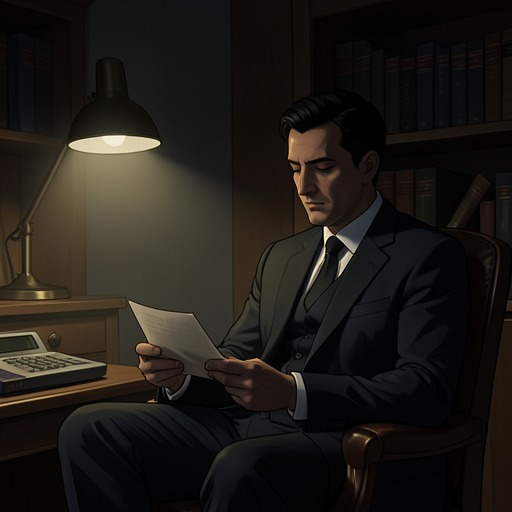
Letter from Jeremiah de Saint-Amour to Juvenal Urbino
Love in the Time of CholeraJeremiah de Saint-Amour’s posthumous letter is the instrument that turns a friend’s death into a crisis of knowledge for Juvenal Urbino. Sealed with so much wax that it must be torn open, and written across eleven sheets on both sides, it reveals a concealed past that unsettles Urbino’s judgment of the man he thought he knew. The letter supplies final instructions, but its deeper force lies in what it discloses—and in the difficulty Urbino has believing it.
Discovery at the Desk
The letter is found among the papers on Jeremiah de Saint-Amour’s desk after Urbino arrives to examine the circumstances of his friend’s death. The night watchman had seen a note nailed to the street door, instructing visitors to enter without knocking and inform the police. While the inspector and an intern search the house, Urbino studies an unfinished chess game; the inspector, meanwhile, finds the sealed envelope addressed to the doctor. Its physical form signals both care and concealment: eleven sheets of diligent handwriting, enclosed under a heavy seal that has to be ripped apart.
Urbino opens the black curtain to get more light and reads the first paragraph. He realizes at once that he will miss Pentecost Communion. The letter’s revelations do not reach him in a calm, uninterrupted reading: he turns back several pages to recover the thread, then finishes with agitated breath. When he folds the sheets again, his lips are as blue as the corpse, and his fingers tremble. The bodily signs make the letter’s effect visible before he explains what he has read: the account has carried him into a past that seems both distant and newly consequential.
Instructions and Concealment
When the letter has been read, Urbino tells the inspector and the young doctor that it contains nothing in particular, only Jeremiah’s final instructions. The description is a half-truth. It is plausible enough to pass as complete, but it suppresses the letter’s revelations and allows Urbino to keep them from the men investigating the death. At the same time, he acts on information contained in the papers: the investigators lift a loose floor tile and find a worn account book with the combination to a strongbox. The money inside is less than expected, but sufficient for funeral expenses and minor obligations.
The letter also redirects Urbino beyond the house. Once in his carriage, he consults it again and orders the coachman to take him to an obscure address in the old slave quarter. The unusual instruction prompts the coachman to check that he has understood correctly. Urbino confirms that the address is clear and that its writer had ample reason to know it. He then returns to the first page and reads again, caught between the revelations’ power to alter his understanding of his life and his suspicion that they may be the ravings of a dying man.
The Friend Reinterpreted
The letter discloses Jeremiah’s true identity and sinister past, along with powers of deception that Urbino finds inconceivable. Before reading it, Urbino had regarded his friend as a saint unaware of his own state of grace; the disclosure makes that settled image untenable. The revelation does not simply add a dark episode to Jeremiah’s biography. Urbino feels that something definitive and irrevocable has happened to him, because his understanding of the man—and of their friendship—has been exposed as dependent on a concealed history.
The letter’s effect is sharpened by what Urbino had already seen at the death scene. In looking at Jeremiah’s body, he had felt, for the first time, that death was physically present rather than merely an imagined certainty. He was glad that Jeremiah had served as the instrument of this encounter. Yet the letter complicates that consolation: the friend who had brought death so near was also, according to the written disclosure, a practiced deceiver. The letter therefore binds together Urbino’s new experience of mortality and his loss of confidence in his knowledge of Jeremiah.
Reading, Refusal, and Aftermath
At home, Urbino gives the folded sheets to Fermina Daza, wanting to carry their secrets with him to the grave. She places them in her dressing table without reading them and locks the drawer. Her refusal creates a stark contrast between the letter’s overwhelming power over Urbino and its failure to compel another reader. Fermina regards her husband’s astonishment and distress as excessive; she cannot see why Jeremiah’s hidden past should undo the esteem he earned after arriving in exile with little, or why a secret woman should be treated as an abomination by a man who has himself had an affair.
Urbino’s objection is not, he insists, simply to Jeremiah’s past or to what he did. What infuriates him is the deception practiced on everyone for so many years. Fermina’s response instead reads the hidden woman as evidence of love: she says that if Urbino decided to die for reasons as serious as Jeremiah’s, her duty would be to do what the other woman had done. The exchange shows how the letter’s meaning depends on the reader. For Urbino it destroys trust in the friend’s apparent life; for Fermina, its disclosure does not erase the love embodied in the final decision. The sheets remain locked away, while the marriage is left with a disagreement over what, precisely, has been revealed.